Description
Leader: Ray DiGiuseppe, Ph.D., Director of Professional Training
Cost: $135.00
Date: Friday, December 4th, 2026 | 1:30 pm EST – 4:45 pm EST
Location: Hybrid: In-person (145 East 32nd Street, 9th Floor, New York, NY 10016) or Zoom
3 Contact Hours/3 Continuing Education Credits will be provided by Albert Ellis Institute upon completion of the workshop.
Target Audience: Psychologists, Social Workers, Mental Health Counselors, Graduate Students
Instructional Level: Introductory
Description:
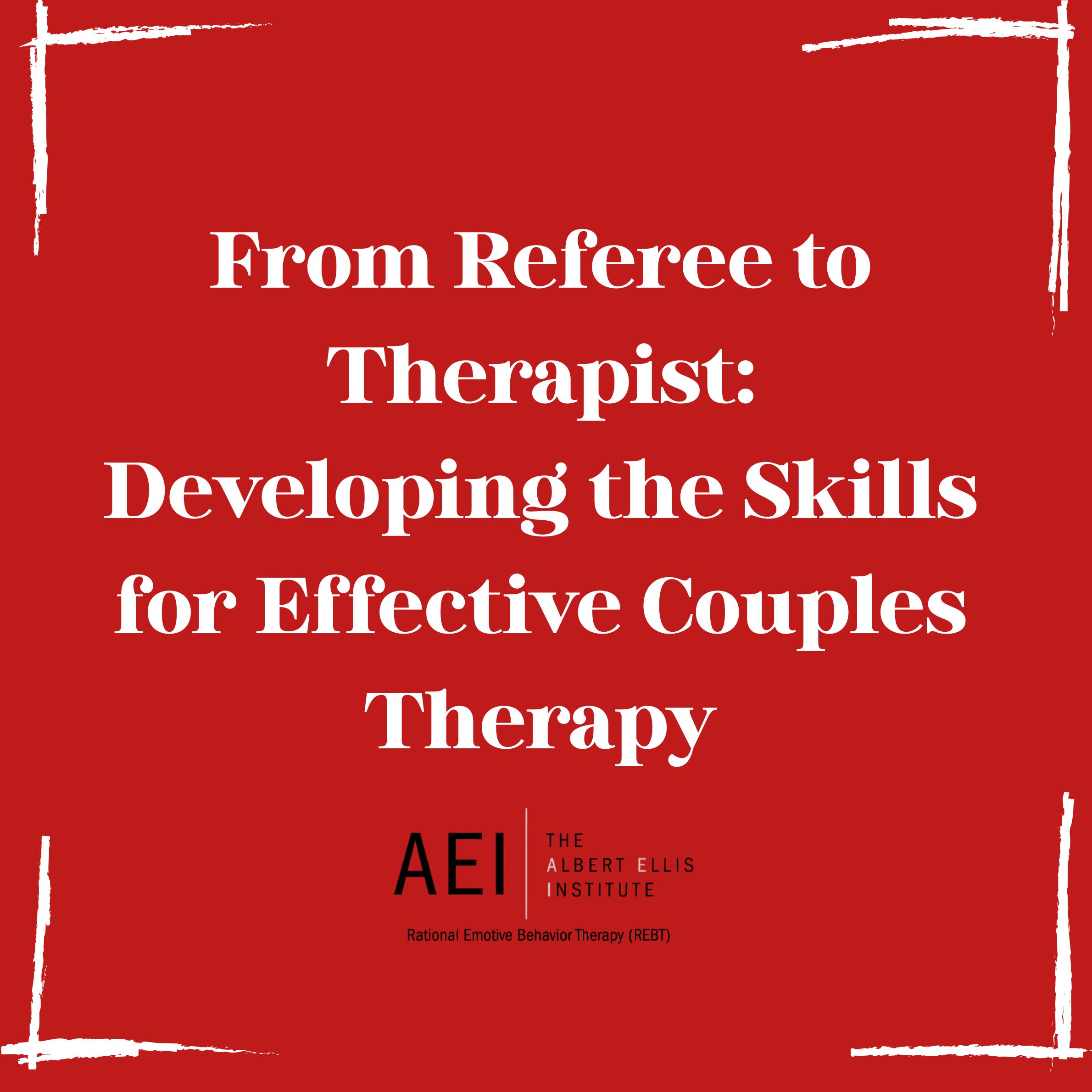
Couples therapy can challenge even experienced clinicians. When two partners are angry, blaming one another, or demanding that the therapist take sides, it can be difficult to know when to intervene, how directive to be, or how to keep the session from becoming overwhelming or unproductive. Therapists may find themselves avoiding conflict, becoming overly involved, worrying about appearing biased, or simply struggling to stay engaged.
This interactive workshop focuses on the therapist skills that make couples therapy more effective—regardless of the theoretical orientation you use. Participants will learn how to remain calm and engaged in the face of intense conflict; interrupt unproductive interactions firmly without becoming punitive; rapidly consider multiple perspectives; become more comfortable with active and directive interventions; and maintain acceptance of clients even when they disapprove of their behavior. Particular attention will be given to recognizing and regulating therapists’ own emotional reactions and staying therapeutically effective when sessions become challenging.
Through discussion, experiential exercises, demonstrations, and role-playing, participants will have opportunities to practice these skills and develop greater confidence in managing the complex interpersonal dynamics of couples therapy.
Participants will leave with effective strategies they can apply immediately to help them stay engaged, balanced, and effective—even when couples therapy gets difficult.
Learning Objectives:
- Identify the difficulties psychotherapist have with couples sessions that interfere with their performance.
- Discuss what couples therapy models have the most empirical support.
- Demonstrate specific therapist skills that make couples therapy more effective.
Schedule:
1:30 pm – 2:00 pm: How does REBT fit into the Behavioral and Cognitive Behavioral Couples therapies?
2:00 pm – 2:30 pm: How do clinicians perceive couples therapy?
2:30 pm – 3:30 pm: What are the therapist skills that clinicians need to implement successful couples therapy?
3:30 pm – 4:00 pm: Self-assessment: What skills do I need to improve to be a more effective couples therapist?
4:00 pm – 4:30 pm: Roleplaying the therapists’ skill in difficult couple session scenarios.
4:30 pm – 4:45 pm: Evaluation of workshop.
Recommended Readings:
Beasley, C. C., & Ager, R. (2019). Emotionally focused couples therapy: A systematic review of its effectiveness over the past 19 years. Journal of Evidence-Based Social Work, 16(2), 144–159. https://doi.org/10.1080/23761407.2018.1563013
Bodenmann, G., Kessler, M., Kuhn, R., Hocker, L., & Randall, A. K. (2020). Cognitive-behavioral and emotion-focused couple therapy: Similarities and differences. Clinical Psychology in Europe, 2(3), Article e2741. https://doi.org/10.32872/cpe.v2i3.2741
Bradbury, T. N., & Bodenmann, G. (2020). Interventions for couples. Annual Review of Clinical Psychology, 16, 99–123. https://doi.org/10.1146/annurev-clinpsy-071519-020546
Christensen, A., Atkins, D. C., Baucom, B., & Yi, J. (2010). Marital status and satisfaction five years following a randomized clinical trial comparing traditional versus integrative behavioral couple therapy. Journal of Consulting and Clinical Psychology, 78(2), 225–235. https://doi.org/10.1037/a0018132
Christensen, A., Doss, B. D., & Jacobson, N. S. (2017). Integrative behavioral couple therapy. Current Opinion in Psychology, 13, 111–114. https://doi.org/10.1016/j.copsyc.2016.04.022
Friedlander, M. L., Escudero, V., Welmers-van de Poll, M. J., & Heatherington, L. (2018). Meta-analysis of the alliance–outcome relation in couple and family therapy. Psychotherapy, 55(4), 356–371. https://doi.org/10.1037/pst0000161
Rathgeber, M., Bürkner, P.-C., Schiller, E.-M., & Holling, H. (2019). The efficacy of emotionally focused couples therapy and behavioral couples therapy: A meta-analysis. Journal of Marital and Family Therapy, 45(3), 447–463. https://doi.org/10.1111/jmft.12336
Rosenberg, T., & Pace, M. (2006). Burnout among mental health professionals: special considerations for the marriage and family therapist. Journal of Marital and Family Therapy. 32(1), 87-99. doi: 10.1111/j.1752-0606.2006.tb01590.x. PMID: 16468683
Spengler, P. M., Lee, N. A., Wiebe, S. A., & Wittenborn, A. K. (2024). A comprehensive meta-analysis on the efficacy of emotionally focused couple therapy. Couple and Family Psychology: Research and Practice, 13(2), 81–99. https://doi.org/10.1037/cfp0000233
Yıldızhan, C., Kafescioğlu, N., Zeytinoğlu-Saydam, S., Erdem, G., Söylemez, Y., & Yumbul, Ç. (2024). Emotion regulation in emotionally focused therapists working with high-conflict couples. Journal of Marital and Family Therapy, 50, 840–866. https://doi.org/10.1111/jmft.12725
Instructor Credentials:
After earning a B.S. degree from Villanova University, Dr. DiGiuseppe received his Ph.D. from Hofstra University in 1975. He completed a postdoctoral fellowship at AEI in 1977. In 1980 he became AEI’s Director of Professional Education, a position he has held since then. He is also a Core Faculty Trainer for Albert Ellis Institute. He has trained hundreds of therapists in Rational Emotive Behavior Therapy (REBT) throughout the world. He received the Jack Krasner Early Career Contribution Award from APA’s Division of Psychotherapy (29) and was elected a fellow of the American Psychological Association’s divisions of Psychotherapy, Clinical, School, and Family Psychology.
Dr. DiGiuseppe joined the faculty of St. John’s University in 1987 and is presently professor and chair of the psychology department. He has been very active in the Association for Behavioral and Cognitive Therapies (ABCT). Dr. DiGiuseppe helped develop the Diplomate in Behavioral Psychology (1986-87) and served on the Diplomate board. He was associate program chair (1995), and program chair (1996) for ABCT. He has served on the editorial board of ABCT’s Cognitive and Behavioral Practice. He served as ABCT convention coordinator (1997 – 2000) and associate convener for the 2001 World Congress for Behavior Therapy. Dr. DiGiuseppe developed and promoted popular convention formats such as the Master Clinician Series and the World Rounds demonstrations. Dr. DiGiuseppe was elected ABCT representative-at-large in 2001 and recently served as President of the organization.
Dr. DiGiuseppe has contributed to the scientific and clinical literature with six books, more than 120 chapters and articles, and hundreds of conference presentations. He has co-authored two psychological tests, The Anger Disorders Scale (for Adults, and the Anger Regulation and Expression Scale (for children and adolescents). He co-authored several books on REBT including the Practitioner’s Guide to Rational Emotive Behavior Therapy. His present scholarship focuses on clinical aspects of anger and REBT, on which he lectures widely.
Cancelling of Registration
| Time Frame (Days before Workshop or Training) | Cancellation Fees | |
| 28 days or more | None | |
| 14 to 27 days | 50% of registration fee | |
| Less than 14 days | 100% of registration fee |
Albert Ellis Institute incurs significant administrative costs related to your registration before a workshop. Therefore, the following fees apply should you either cancel or request to transfer your registration to a different workshop or training date.
If you wish to cancel your registration, a notification should be sent in writing to info@albertellis.org. Refunds will be provided as noted above with associated relevant fees.
Any necessary information related to inclement weather that will affect a workshop/training will be emailed to the address you have provided us or is available by calling 212-535-0822 during usual business hours.
There are times when Albert Ellis Institute may need to cancel a workshop/training. We would only do so with good reason, however, we reserve this right, as well as the right to reschedule workshops/trainings and/or substitute presenters. If we need to cancel or reschedule a workshop/training, we will transfer your registration to the next available scheduled workshop/training on that particular topic. If you cannot or choose not to transfer your registration, you may request a full refund of workshop/training fees paid.
Albert Ellis Institute disclaims any liability for any losses or damages, direct or indirect, arising from a workshop/training cancellation and will not be held responsible for any associated costs incurred with respect to travel, accommodation, US visa application fees, or related fees.


Albert Ellis Institute is approved by the American Psychological Association to sponsor continuing education for psychologists. Albert Ellis Institute maintains responsibility for this program and its content.
Albert Ellis Institute has been approved by NBCC as an Approved Continuing Education Provider, ACEP No. 5145. Programs that do not qualify for NBCC credit are clearly identified. Albert Ellis Institute is solely responsible for all aspects of the programs.
Albert Ellis Institute is recognized by the New York State Education Department’s State Board for Psychology as an approved provider of continuing education for licensed psychologists #PSY-0133.
Albert Ellis Institute is recognized by the New York State Education Department’s State Board for Social Work as an approved provider of continuing education for licensed social workers #SW-0131.
Albert Ellis Institute is recognized by the New York State Education Department’s State Board for Mental Health Practitioners as an approved provider of continuing education for licensed mental health counselors #MHC-0019.